Granite and quartz sinks are often grouped together because both belong to the category of stone-like composite sinks. They share a similar premium look, a dense feel, and a reputation for being more durable than many stainless steel or ceramic options. However, the differences between granite sinks and quartz sinks can be meaningful, especially when the decision is based on stain behavior, color consistency, long-term appearance, and how predictable the sink will be across large orders or repeat projects.
In practical sourcing terms, the key question is not which material sounds better, but which sink type matches your kitchen usage, cleaning habits, design expectations, and installation needs. This article explains how granite and quartz sinks differ, how those differences show up in real kitchens, and how to choose a sink style that fits your project. ROCKY supplies quartz sink options in multiple installation types, including Top Mount Sink, Undermount Sink, and Apron Front Sink, so you can select an option that aligns with both design and performance requirements.
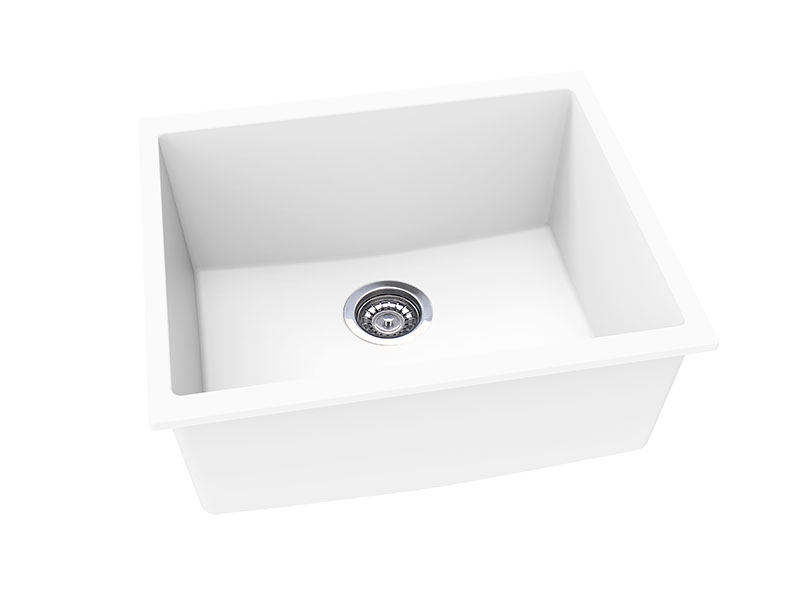
Granite sinks are commonly made from granite composite, which typically combines crushed granite or stone particles with a resin binding system. Quartz sinks are commonly made from quartz composite, which typically combines quartz particles with a binding system to form a dense engineered structure. Both are engineered materials rather than carved single-stone basins, which allows them to be produced in consistent shapes, sizes, and colors.
The difference is largely in the mineral base and how it influences surface performance, visual behavior, and consistency. The mineral particle type, particle size distribution, and how the binder interacts with the mineral all affect the final surface, even when two sinks appear similar at a glance.
For many buyers, appearance consistency is the first deciding factor. A sink is often paired with countertops, faucets, and cabinet colors, and the sink must remain visually stable under different lighting conditions.
Quartz sinks are often chosen for their refined appearance and predictable color tone across production batches. This matters when the project requires multiple sinks to match, such as multi-unit residential developments, hotel projects, or repeat orders for the same kitchen collection. Consistent tone and texture make it easier to maintain a uniform design language.
Granite composite sinks can also look premium, but some buyers find that the surface appearance can vary more depending on the specific granite blend, granule pattern, and color formulation. This is not necessarily a negative, because some designers prefer a more speckled, natural stone-like look. The practical point is that the visual style and batch matching expectations can be different.
Granite composite sinks often present a slightly more textured, speckled surface due to how granite particles and surface finishing interact. This can help hide water spots and minor marks, which some users appreciate for busy kitchens.
Quartz sinks often have a more uniform visual field, which can feel more modern and clean, especially in minimalist kitchens. The perceived smoothness and consistency can make cleaning more predictable because stains and residues are easier to visually identify and remove. In practice, the better experience depends on whether the user prefers a subtle textured look that hides everyday spots or a uniform finish that emphasizes clean design.
Both granite and quartz composite sinks are designed to be stain resistant, but the practical difference often shows up in how the sink responds to certain kitchen stains and how quickly those stains must be cleaned.
Quartz sinks are commonly selected when buyers want strong stain resistance with stable long-term appearance. A well-made quartz sink surface is engineered to reduce absorption pathways that lead to lingering stains, helping maintain a consistent look over time.
Granite composite sinks also resist staining well, but results can vary based on formulation and surface finish. In some designs, the speckled pattern can visually disguise minor staining, which makes the sink appear cleaner even when it has been used heavily. The most important factor for both materials is consistent cleaning habits, especially after exposure to high-pigment liquids such as coffee, wine, sauces, and oils.
Scratch behavior is not only about whether the surface gets damaged. It is also about whether scratches are visible and whether the surface develops gloss change in high-contact zones.
Quartz sinks are often preferred when buyers want a surface that maintains a consistent premium appearance with strong resistance to everyday abrasion. If the sink is used heavily, it is important that the surface does not quickly look “polished” in certain zones from repeated contact.
Granite composite sinks can also be durable and scratch resistant, but the visible wear pattern can differ due to surface texture and color granule distribution. Some granite composites hide micro-scratches well because the speckled look breaks up light reflections.
Both materials still benefit from avoiding aggressive abrasive pads, because harsh abrasion can gradually affect surface finish regardless of mineral type.
Hard composite sinks can chip if struck sharply by heavy cookware, especially at corners or thin edges. The more relevant difference is how the sink distributes force and how consistent the sink structure is.
Quartz sinks are typically engineered for a dense and stable body, which helps distribute impact loads through the structure. Granite composite sinks are also designed for toughness, though behavior depends on the specific granite content and binder system. In practical terms, both are durable for normal kitchen use, and the biggest risk factors are dropping heavy cast iron directly onto sharp edges and installation stress that creates long-term weakness at mounting points.
Kitchens expose sinks to hot water, boiling cookware, and rapid temperature changes. Both granite and quartz composites generally handle routine hot water well. The higher-risk scenario for any rigid sink material is extreme thermal shock, such as placing a very hot pan into a cold sink with standing cold water.
Quartz sinks are often selected for stable performance under normal kitchen temperature changes, but it is still best practice to use a sink grid or trivet for extremely hot cookware. Granite composite sinks also handle typical heat exposure well, yet performance depends on formulation and finishing. For long-term durability, the safest approach is to minimize repeated extreme thermal shock for either sink type.
Both granite and quartz composite sinks are usually quieter than thin stainless steel sinks. Their dense structure absorbs vibration and reduces the sharp ringing sound often associated with metal sinks. This makes both options attractive for open-plan kitchens where noise control matters.
Differences in sound behavior can vary by sink thickness and structure rather than by mineral type alone. In project selection, it is more useful to look at the sink’s overall build and installation method than to expect one category to always be quieter.
The table below summarizes the typical differences buyers consider when selecting between granite and quartz sinks. Actual performance depends on the specific formulation and manufacturing quality.
| Decision Factor | Granite Composite Sink | Quartz Composite Sink |
|---|---|---|
| Visual style | Often speckled, natural stone-like look | Often more uniform, refined appearance |
| Color matching | Can vary more by blend and granule pattern | Often more consistent tone across batches |
| Stain behavior | Strong stain resistance, speckle can hide minor marks | Strong stain resistance with stable appearance |
| Scratch appearance | Durable, micro-wear may be less noticeable | Durable, maintains clean modern look |
| Cleaning experience | Texture can hide spots, may feel more stone-like | Uniform surface supports predictable cleaning |
| Project repeatability | Depends on color system and batch control | Often preferred for repeat projects and matching |
This comparison is useful for narrowing choices, but final decisions should consider sink style, installation method, and the specific project environment.
Material differences matter, but installation style can be just as important for real-world performance. The same sink material can perform differently depending on how it is supported and how stress is distributed.
Top Mount Sinks are often selected for reliable installation and practical replacement because the rim rests on the countertop and helps distribute weight. ROCKY’s Top Mount Sink options support kitchens where installation simplicity and stable rim support are priorities.
Undermount Sinks create a clean countertop edge and make it easier to wipe water and crumbs directly into the basin. Durability depends on correct brackets, adhesives, and long-term support. ROCKY’s Undermount Sink options match projects seeking a modern finish with a premium countertop line.
Apron Front Sinks are often chosen for design impact and comfortable workflow at the sink. They require correct cabinet sizing and support structure for long-term stability. ROCKY’s Apron Front Sink options fit projects where both visual presence and durable daily performance are required.
If your project prioritizes a speckled stone look that visually hides small marks and blends into a natural countertop palette, granite composite sinks can be a strong fit. If your project prioritizes consistent color tone, a modern refined appearance, and repeatable matching across multiple units or repeat orders, quartz sinks are often the preferred choice.
For many buyers, the decision is also influenced by brand positioning. Quartz sinks are commonly used in designs that aim for clean minimal surfaces and consistent styling across an entire kitchen collection. Granite composite sinks are often used when a more traditional stone-like character is desired.
Granite and quartz sinks share many strengths, including a dense feel, reduced noise compared with metal sinks, and strong durability for everyday kitchen use. The most meaningful differences usually appear in visual style, color consistency, cleaning experience, and how predictable the surface looks across large orders or repeat projects. Granite composite sinks often present a more speckled stone character, while quartz sinks often offer a more uniform and refined appearance with strong batch-to-batch consistency.
For projects that require consistent design matching and reliable long-term appearance, quartz sinks remain a popular choice. ROCKY provides quartz sink solutions in multiple installation styles, including Top Mount Sink, Undermount Sink, and Apron Front Sink, enabling buyers to match both aesthetics and installation requirements.
Previous: How High Should a Bathroom Niche Be?

 Mobile Phone:
 Contact Now